Modern commercial building design prioritizes accessible, smooth, and efficient entry systems that welcome visitors while supporting facility operations. As foot traffic increases across retail centers, healthcare facilities, office towers, and public institutions, traditional manual entry doors often create operational bottlenecks, accessibility barriers, and unnecessary thermal loss. Upgrading to automatic commercial door operators is one of the most effective structural investments a business or facility manager can make. Automatic door systems improve accessibility standards, optimize traffic movement, reduce energy expenditure, and elevate the overall user experience.
The Operational Case for Automatic Commercial Doors
Transitioning from manual entrance hardware to automated entry systems delivers functional benefits that extend far beyond modern visual appeal. Facilities that implement automatic doors address several core operational priorities simultaneously.
Universal Accessibility and Regulatory Compliance
Commercial properties must accommodate visitors of all physical capabilities. Manual doors with heavy closers present significant obstacles for seniors, individuals using mobility aids, parents with strollers, and delivery personnel carrying cargo. Automatic swing operators, sliding sensor doors, and touchless wave-to-open actuators ensure seamless, barrier-free access, aligning facility entrances with modern building codes and accessibility regulations.
Optimized Traffic Flow in High-Density Entrances
During peak business hours, manual doors slow foot traffic as individuals pause to pull or push heavy door slabs. In high-volume locations such as grocery stores, airports, medical clinics, and educational campuses, automatic sliding doors detect approaching pedestrians from both directions, opening fluidly and closing promptly to allow continuous, unimpeded foot traffic.
Superior Thermal Envelope Control and Energy Savings
Conditioned air escapes every time an exterior entrance door opens. However, manual doors are often propped open during deliveries or fail to close completely due to improper hydraulic latching. Automatic door systems use precise motion and presence sensors to open only when necessary and close immediately once a pedestrian passes through the opening. This rapid cycle time limits thermal exchange, reduces drafts in lobby areas, and lowers daily heating and cooling demands on HVAC systems.
Main Types of Commercial Automatic Door Systems
Selecting the appropriate automated door configuration depends on structural space, existing door framing, traffic volume, and primary usage requirements.
| System Type | Operational Mechanism | Ideal Commercial Applications |
|---|---|---|
| Low-Energy Swing Operators | Motorized overhead header operators that automate existing swing doors via push-plate or touchless sensor activation. | Office lobbies, public washrooms, school entrances, and lower-traffic commercial doors. |
| Full-Power Automatic Swing Doors | Heavy-duty electro-hydraulic operators equipped with safety sensor mats or overhead sensors for continuous automatic swinging. | Hospital entrances, high-density public facilities, and busy retail corridors. |
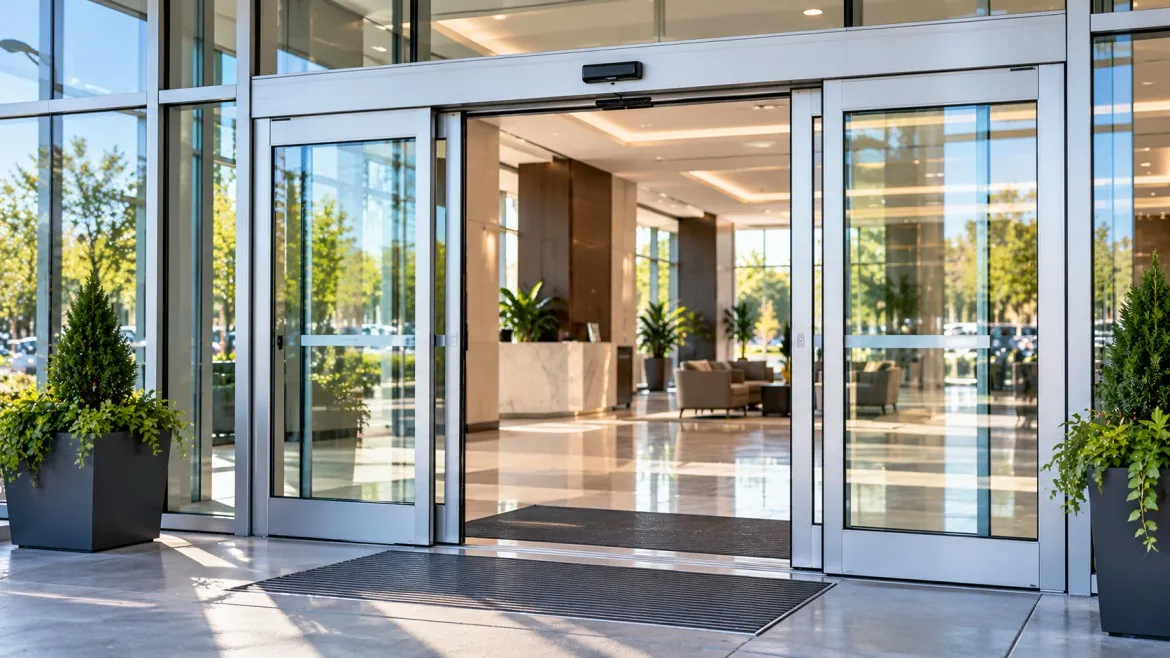
| Automatic Sliding Door Systems | Bi-parting or single-slide glass panels sliding horizontally along an overhead track driven by a motorized header mechanism. | Supermarkets, shopping malls, airport terminals, and modern corporate entrances. |
| Telescopic Sliding Doors | Multiple narrow door panels that slide and stack together, maximizing usable passage width in tight spaces. | Narrow vestibules, medical facilities with stretcher traffic, and compact retail storefronts. |
Sensor Technology and Operational Safety Systems
Modern automatic commercial doors rely on sophisticated sensor arrays to ensure reliable operation while preventing accidental contact with pedestrians or equipment.
Microwave Motion Sensors
Positioned above the door header, microwave motion sensors detect movement within a wide activation field approaching the entrance. These sensors trigger the opening cycle when a pedestrian or shopping cart approaches, offering reliable long-range motion detection.
Active Infrared Safety Sensors
Installed directly over the doorway threshold and along moving door panels, active infrared presence sensors create a focused protective curtain. If an individual, wheelchair, or stationary object remains within the door swing path or sliding threshold, the sensor holds the door open or immediately reverses its direction to avoid physical contact.
Touchless Wave Actuators
In environments requiring strict hygiene protocols such as medical facilities, food production plants, and public restrooms touchless wave-to-open switches allow users to activate entry operators by simply waving a hand near an optical sensor. This eliminates touchpoints, reducing the spread of surface-borne contaminants.
Steps in the Automatic Door Upgrade and Installation Process
Upgrading a commercial facility to automated entry operators involves careful structural evaluation, electrical integration, and safety calibration.
1. Architectural and Site Evaluation
Technicians evaluate structural framing, door slab weight, header support, clear opening width, and nearby power sources. Existing manual doors are assessed to determine whether low-energy operators can be retrofit or if a full automatic sliding door package is required.
2. Header and Operator Mounting
For swing upgrades, heavy-duty operator headers are secured to structural wall framing above the door frame. For sliding assemblies, track channels and motor drives are mounted, and glass or aluminum door panels are aligned within top and bottom guides.
3. Electrical Wiring and Sensor Calibration
High-voltage electrical lines power the motor drive, while low-voltage wiring links motion sensors, safety presence sensors, emergency stop switches, and access control interfaces to the central logic controller.
4. Safety Testing and Speed Calibration
Technicians program opening speed, hold-open time, closing force, and latching speed according to safety standards. Sensor coverage zones are field-tested with physical walkthroughs to confirm presence detection across the entire threshold.
When business owners and facility planners decide to modernize their property entrances, investing in professional automatic door installation ensures that equipment is properly integrated, sensor zones are calibrated to safety standards, and long-term mechanical reliability is preserved.
Integration with Commercial Access Control Systems
Automatic door operators easily integrate with advanced commercial building security and access control infrastructure. Facilities requiring controlled access outside normal operating hours can connect automatic door controllers to keycards, electronic keypads, biometrics, or cloud-based mobile access platforms.
During business hours, the system functions as a free-flowing automatic entrance. After hours, motion sensors automatically deactivate, and magnetic locks or electric strikes engage. Authorized personnel scanning an approved credential temporarily trigger the lock release and activate the automatic door operator, allowing hands-free, secure entry. Furthermore, automatic door systems link directly to fire alarm control panels, ensuring doors automatically unlock or open during emergency evacuations.
Essential Maintenance Practices for Automated Entrances
Because automatic commercial doors contain sophisticated electronic logic boards, electric motors, drive belts, and sensitive motion sensors, routine maintenance is essential to prevent unplanned downtime:
- Daily Sensor Checks: Walk through activation zones daily to ensure sensors detect approach at normal walking speeds and hold doors open while standing in the threshold.
- Keep Tracks and Guides Clean: Sweep and vacuum sliding door floor guides regularly to prevent dirt, salt, and debris from binding lower guide rollers.
- Inspect Drive Belts and Arms: Check drive belts, linkage arms, and mounting hardware monthly for signs of looseness, mechanical wear, or alignment drift.
- Verify Emergency Battery Backups: Test battery power backup units regularly to confirm that automatic doors remain functional or fail-safe during power outages.
Upgrading to automatic commercial door operators transforms a simple entrance into an efficient, safe, and accessible gateway that strengthens property value, lowers energy consumption, and reflects a modern standard of service for every visitor.