Building a new home creates a long list of decisions.
How large should the house be?
Which floor plan works best?
How much flexibility do you want with materials, finishes, room sizes, and architectural details?
But before answering any of those questions, homeowners usually need to make a more fundamental choice:
Should you work with a custom home builder or a production builder?
Both approaches can result in a well-built home, but the experience is very different.
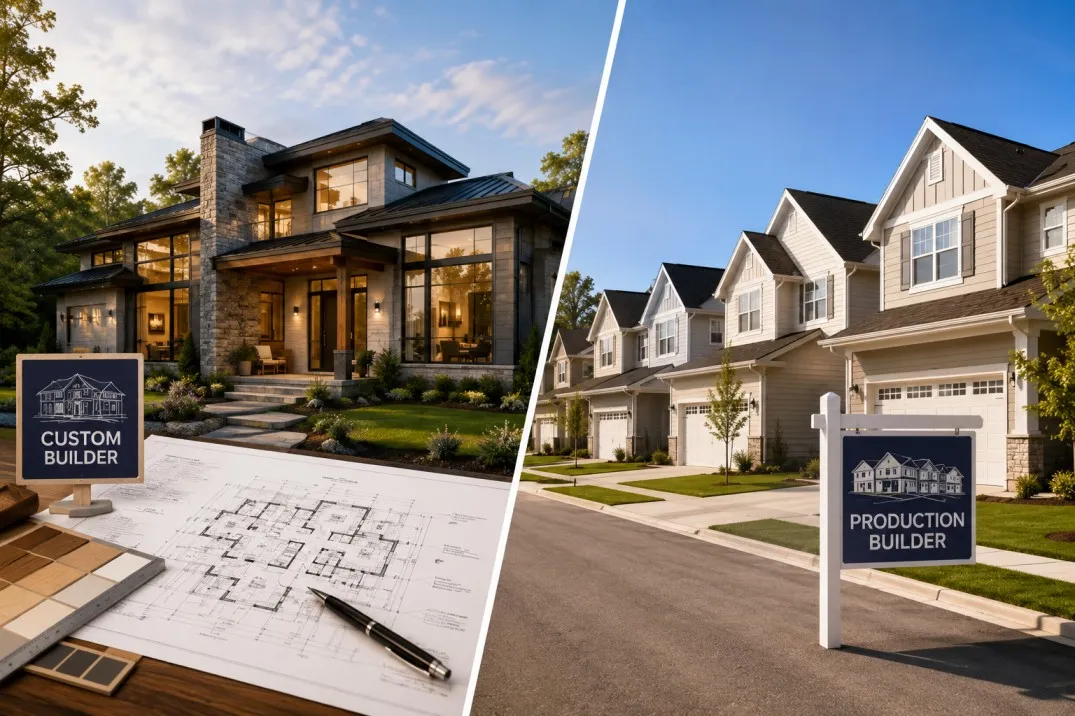
Production builders generally offer a more standardized process built around predefined floor plans and selections. Custom builders typically provide greater flexibility, allowing the home to be designed around a specific property, household, and set of priorities.
Neither model is automatically better.
The right choice depends on budget, timeline, design expectations, lot conditions, and how much control the homeowner wants throughout the process.
Homeowners comparing a custom home builder vs. production builder should look beyond the finished appearance and consider how each building model affects design flexibility, lot selection, material choices, construction planning, and the overall experience.
What Is a Production Builder?
A production builder typically constructs homes using a collection of established floor plans.
These homes may be built within:
- planned communities,
- subdivisions,
- larger residential developments.
Buyers usually choose from several models and then personalize the home using a predefined menu of options.
Those options might include:
- flooring,
- cabinet colors,
- countertops,
- fixtures,
- paint,
- appliance packages,
- limited structural upgrades.
Because the builder uses similar plans, materials, construction methods, and subcontractors repeatedly, the process can be highly standardized.
That standardization can create advantages in pricing and scheduling.
The tradeoff is that buyers usually have less freedom to make major changes.
What Is a Custom Home Builder?
A custom home builder generally creates a home around the specific needs of the homeowner and property.
Instead of beginning with a fixed model, the process may begin with questions such as:
- How does the family live?
- What rooms are most important?
- How should the home relate to the lot?
- What views should be emphasized?
- How much privacy is needed?
- What materials and architectural style are preferred?
A custom project can involve architects, designers, engineers, contractors, and specialized trades working together to develop the home from the ground up.
The process offers significantly more flexibility, but it also requires more decisions.
Custom construction is therefore usually more collaborative and more involved than selecting a production model.
1. How Much Design Freedom Do You Want?
Design freedom is one of the clearest differences between the two approaches.
Production Home
A production builder may offer several floor plans with selected modifications.
For example, buyers may be able to choose:
- an optional bedroom,
- a different kitchen package,
- a larger primary bathroom,
- alternative flooring,
- upgraded cabinetry.
But major changes to the basic footprint or structural design may not be available.
Custom Home
A custom home can usually be developed around the homeowner's requirements from the beginning.
That may allow more control over:
- room sizes,
- ceiling heights,
- kitchen layout,
- window placement,
- storage,
- home offices,
- accessibility,
- indoor-outdoor connections.
If design flexibility is one of the primary reasons for building rather than buying an existing home, the custom route may be more appropriate.
2. Choosing Your Lot
The property itself can strongly influence the building decision.
Production homes are frequently connected to specific developments.
The buyer may choose among available lots, but the options are limited to properties controlled or serviced by the builder or developer.
Custom construction offers more flexibility.
A homeowner might already own a lot or purchase one independently.
That can be especially important when the property has:
- significant views,
- unusual topography,
- mature trees,
- waterfront access,
- an irregular shape.
The house can then be designed in response to those site conditions.
For example, window placement might be oriented toward a view rather than dictated by a standard plan.
Outdoor living areas can be positioned according to sunlight and privacy.
The lot becomes part of the architecture rather than simply a location for a predefined building.
3. Floor Plans and Layout Flexibility
Production builders usually optimize their floor plans through repetition.
That can produce practical layouts that have already been built many times.
For buyers whose needs fit one of those plans, this can be an efficient solution.
The challenge appears when the household has unusual priorities.
Perhaps the homeowner needs:
- two home offices,
- a first-floor bedroom for aging parents,
- a large workshop,
- a music room,
- a particular kitchen configuration,
- an accessible bathroom,
- specialized storage.
Modifying a production floor plan to accommodate highly specific requirements may not be possible.
Custom construction allows those priorities to shape the plan from the beginning.
This can be particularly valuable when the household already knows which features were missing from previous homes.
4. Materials and Finish Selections
Production builders usually create a controlled selection process.
Buyers may visit a design center or choose from approved packages.
Options might include several:
- cabinet styles,
- countertop materials,
- flooring products,
- plumbing fixtures,
- paint schemes.
This keeps the process manageable.
The builder already knows how the products perform and how they fit within the construction schedule.
Custom homes typically offer a much wider range of choices.
Homeowners may be able to specify:
- custom cabinetry,
- specialty tile,
- particular stone,
- unique flooring,
- custom millwork,
- specialized windows,
- architectural lighting,
- premium plumbing fixtures.
That flexibility can create a more personalized home.
It can also create more decisions, longer lead times, and potentially higher costs.
5. Custom Home vs. Production Home Cost
Cost is one of the biggest considerations.
Production builders can often control costs through repetition.
They may purchase materials in larger quantities, use standardized plans, and work with established construction teams.
That can reduce some design and construction expenses.
Custom homes are usually more variable.
Cost can depend on:
- land,
- architecture,
- engineering,
- site conditions,
- materials,
- finishes,
- structural complexity,
- landscaping,
- utility work.
A highly customized design can also involve features that require specialized labor or fabrication.
However, a custom home does not necessarily mean every component must be luxury-grade.
Homeowners can still prioritize spending.
For example, they may choose to invest heavily in the kitchen and building envelope while using simpler finishes elsewhere.
The advantage is that the budget can be allocated according to individual priorities.
6. How Construction Timelines Compare
Production construction often benefits from established systems.
The builder may have built the same or similar model many times.
That creates familiarity with:
- drawings,
- subcontractor sequencing,
- materials,
- inspections.
Some design and engineering work has already been completed.
This can make the schedule more predictable.
Custom homes usually have a longer planning phase.
Before construction begins, there may be:
- site evaluation,
- architectural design,
- structural engineering,
- permitting,
- selections,
- pricing.
That does not mean the process is inefficient.
Much of the additional time reflects the fact that the home is being developed specifically for one owner rather than repeated from an established model.
Homeowners should compare the entire timeline from design through completion rather than construction months alone.
7. How Much Control Do You Want During Construction?
Some buyers want to make a limited number of choices and allow the builder to handle the rest.
Production construction can work extremely well for that type of homeowner.
The process is structured.
The number of decisions is controlled.
Custom construction generally requires more involvement.
Homeowners may participate in decisions involving:
- architectural details,
- materials,
- lighting,
- cabinetry,
- plumbing fixtures,
- hardware,
- landscaping.
For some people, this is one of the most enjoyable parts of building a home.
For others, it can feel overwhelming.
Before choosing a builder type, homeowners should honestly consider how involved they want to be.
When a Production Home Makes More Sense
A production home may be the better choice when:
- an existing model already fits the household,
- the buyer wants a more standardized process,
- schedule predictability matters,
- fewer design decisions are preferred,
- the development location is attractive,
- major customization is not necessary.
There is nothing inherently inferior about selecting an established design.
If the plan works, paying for a completely custom architectural process may provide little additional value.
Production construction can be an efficient way to obtain a new home with modern systems and finishes without developing every detail from zero.
When a Custom Home Makes More Sense
Custom construction becomes more attractive when the homeowner has priorities that cannot easily be met by a standard plan.
This may include:
- a unique property,
- unusual household requirements,
- a specific architectural style,
- specialized rooms,
- strong indoor-outdoor relationships,
- custom materials.
When the goal is to design the floor plan, materials, building systems, and architectural details around a specific household rather than modify a predefined model, custom home construction provides considerably more flexibility.
The homeowner is not simply choosing a house.
They are helping define how it should work from the beginning.
Energy Efficiency and Building Systems
Custom construction can also provide more control over building performance.
Homeowners may want to prioritize:
- high-performance insulation,
- efficient windows,
- heat pumps,
- solar preparation,
- EV charging,
- energy monitoring,
- advanced ventilation.
Production builders may offer some of these features as upgrades.
A custom project can integrate them into the design from the start.
For homeowners focused on energy performance, the building envelope and mechanical systems can be treated as core design elements rather than optional additions.
Smart Home Technology
Technology is another area where customization may matter.
A homeowner might want:
- structured networking,
- security wiring,
- smart lighting,
- motorized shades,
- whole-home audio,
- automated water shutoff,
- energy monitoring.
Some production builders offer technology packages.
Custom construction provides more freedom to coordinate technology infrastructure with the electrical and interior design plans.
This can be particularly useful for wiring that will later be hidden behind finished walls.
Accessibility and Long-Term Planning
Building a home creates an opportunity to think decades ahead.
A homeowner planning to remain long term may want features such as:
- minimal steps,
- wider doorways,
- accessible showers,
- first-floor sleeping spaces,
- flexible rooms.
These features can be incorporated naturally during custom design.
Production plans may also offer accessibility options, but the available modifications will depend on the builder.
Households with specific long-term needs should discuss those requirements early.
Architectural Character
Some buyers want a home that looks noticeably different from neighboring properties.
Custom construction provides greater control over:
- rooflines,
- window proportions,
- exterior materials,
- entrances,
- interior detailing.
Production communities often maintain more consistency between houses.
That can create an attractive neighborhood identity, but it also means individual homes may share similar forms and materials.
The choice comes down to preference.
Some homeowners value neighborhood consistency.
Others want architecture that is specific to their property and style.
The Design Process Is Different Too
A production buyer typically chooses from an established design framework.
A custom project often begins with conversations rather than floor plans.
The team may ask:
- Where does the family spend most of its time?
- Is entertaining important?
- Does anyone work from home?
- How much storage is needed?
- Which rooms need privacy?
- How should the home connect to the yard?
These questions gradually turn into a design.
This process can uncover needs that homeowners had not initially considered.
The result is usually more personalized, but it requires more collaboration.
What About Resale?
Resale should be considered, but it should not control every decision.
Production homes can appeal to a broad audience because the layouts are generally designed around common household needs.
Custom homes can also perform well, especially when customization improves function rather than becoming overly specialized.
The biggest risk comes from features that are extremely specific.
A highly unusual layout may work perfectly for one homeowner but appeal to fewer buyers later.
Good custom design balances personalization with basic residential functionality.
Quality Depends on the Builder, Not the Label
It is important not to assume that every custom builder produces higher-quality work or every production builder produces lower-quality work.
Quality depends on:
- management,
- subcontractors,
- materials,
- supervision,
- documentation,
- construction standards.
A production builder can construct a durable, well-executed home.
A poorly managed custom project can still have problems.
Homeowners should evaluate the actual builder rather than relying only on the business model.
Questions to Ask a Production Builder
Before choosing a production home, consider asking:
- Which floor plans are available?
- What structural options can be changed?
- Which finishes are included?
- Which items are upgrades?
- Can appliances be changed?
- What energy-efficiency features are standard?
- How are change requests handled?
- What is the expected schedule?
- What warranties are provided?
Understanding what is fixed and what is flexible helps prevent surprises.
Questions to Ask a Custom Home Builder
For a custom project, useful questions include:
- How does the design process work?
- Who provides architectural design?
- How is the construction budget developed?
- When are engineering and site conditions evaluated?
- Who coordinates permits?
- How are selections managed?
- How are long-lead items tracked?
- Who manages the construction site?
- How are changes documented?
- What projects of similar complexity has the builder completed?
The answers can reveal how organized the process is before construction even begins.
Do Not Choose Based Only on the Initial Price
A lower advertised price does not necessarily represent the final comparison.
Homeowners should understand what each price includes.
Production homes may offer upgrades beyond the base price.
Custom estimates may contain allowances for products that have not yet been selected.
Land preparation and utility work may also affect custom construction.
Compare:
- total scope,
- included finishes,
- site work,
- design costs,
- permits,
- allowances.
The goal is to compare realistic completed homes rather than two numbers representing different scopes.
Consider the Decision-Making Experience
This factor is easy to underestimate.
Custom construction requires many decisions.
At various points homeowners may choose:
- windows,
- doors,
- cabinets,
- tile,
- flooring,
- fixtures,
- lighting,
- paint,
- hardware.
Some people enjoy that process.
Others prefer a curated selection.
A production builder reduces decision fatigue by limiting options.
A custom builder offers freedom but also responsibility.
Neither experience is universally better.
Final Thoughts
The difference between a production builder and a custom home builder is about much more than appearance.
Production construction offers a structured process, established floor plans, controlled selections, and often greater schedule predictability.
Custom construction offers more control over the lot, floor plan, materials, building systems, and architectural character.
The right choice depends on what the homeowner values most.
If an existing floor plan already meets your needs and you prefer a simpler decision-making process, a production home may be the better fit.
If you have a specific property, unusual requirements, or a strong vision for how the house should function, custom construction may provide the flexibility you need.
The most useful question is not:
“Which type of builder is better?”
It is:
“How much of this home do I want to define myself?”
The answer usually makes the decision much clearer.