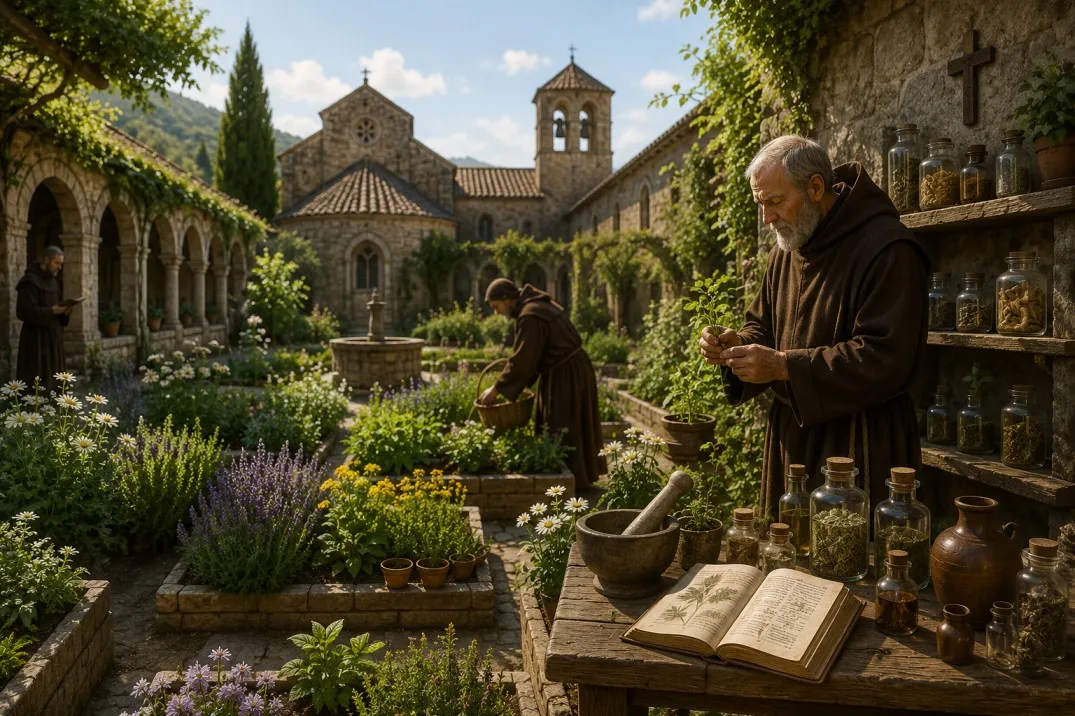
Long before pharmacies existed as we know them, European monasteries were the closest thing to a medical system most people had access to. Monks and nuns maintained physic gardens, carefully organized plots dedicated entirely to medicinal plants, and the knowledge of how to use them was recorded, copied, and passed down through generations of religious communities with far more consistency than the oral traditions of the surrounding countryside. For much of the medieval period, if you were sick and lived anywhere near a monastery, this garden and the people who tended it represented your best chance at actual care.
The scale of some of these gardens is easy to underestimate today. Larger monasteries maintained dozens of distinct medicinal plants, each grown, harvested, and processed according to written instructions that had often been copied and recopied for centuries, sometimes tracing back to classical Roman and Greek medical texts that had otherwise been lost to the general population during the collapse of the Western Roman Empire. Monasteries functioned as unlikely libraries of practical medical knowledge during a period when most other forms of written record-keeping had become rare.
The Structure and Purpose of a Physic Garden
These gardens weren't random collections of pretty flowers. Every plant had a documented purpose, from treating fevers to soothing digestive troubles to caring for wounds. Monastery infirmaries relied on this knowledge daily, and the monks who tended these gardens became some of the most skilled herbalists of their era, blending observation, tradition, and whatever fragments of classical medical texts had survived into the medieval period into a working, practical system of care.
Physic gardens were often laid out with deliberate structure, organized into distinct beds by purpose or plant family, and maintained with the same careful attention a modern pharmacy gives to organizing its shelves. This wasn't decorative. A monk responsible for the infirmary needed to locate the right plant quickly, at the right stage of growth, and mistakes in identification could be genuinely dangerous given how many medicinal plants have toxic relatives or toxic parts.
Calendula's Steady Place in Monastery Gardens
Marigold, known botanically as calendula, held a steady place in these gardens across multiple centuries and regions. Its bright, sun-like blooms made it easy to grow and identify, and its reputation for skin healing meant it saw regular use in the treatment of wounds, burns, and irritated skin among the people the monasteries served. It was often prepared as an infused oil or salve, though records also show it steeped as a simple drink, similar to how people today enjoy calendula tea as a gentler, everyday way to bring the plant into their routine.
Part of what made calendula such a reliable staple in these gardens was its forgiving nature as a plant. It grew readily in a range of soil conditions, bloomed for months at a stretch, and reseeded itself with little intervention, which mattered enormously in a monastic setting where labor needed to be divided across prayer, farming, manuscript copying, and dozens of other daily responsibilities. A plant that essentially took care of itself while still providing genuine medicinal value was worth its garden space many times over.
How Monastery Records Preserved This Knowledge
The written records monasteries kept about their gardens are part of why so much of this knowledge survived into the modern era at all. Herbals, essentially illustrated reference books describing plants and their uses, were painstakingly copied by hand and passed between monasteries across Europe. These documents preserved not just plant identification but detailed notes on preparation methods, dosing, and observed effects, creating a body of practical knowledge that would otherwise have been lost to time, war, and the general chaos of the medieval period.
This tradition of careful documentation is directly responsible for why we still have detailed historical records of how plants like calendula were used centuries ago. Without monastery scribes treating this information as worth preserving generation after generation, much of what we now consider foundational herbal knowledge would have disappeared entirely, passed down imperfectly through oral tradition alone until details were lost or distorted beyond recognition.
The Role of Monastic Infirmaries in Daily Life
Monastery infirmaries served far more than just the monks and nuns living there. Many monasteries maintained a broader charitable mission of caring for the sick from surrounding villages, which meant the herbal knowledge developed and preserved within monastery walls had a direct, practical impact on the health of entire communities, not just the religious population itself. This charitable function gave monastery gardens a kind of civic importance that extended well beyond their walls.
This wider community role also meant monastery herbalists needed practical, reliable knowledge rather than purely theoretical or symbolic plant use. People showing up with genuine wounds, fevers, and illnesses needed treatments that actually worked, at least well enough to be worth the trip. This practical pressure likely helped refine and preserve the more effective traditional uses over centuries, while less useful practices had less reason to persist once put to a real test against real patients.
How Trade and Travel Spread Herbal Knowledge
Monastery gardens didn't develop in isolation. Trade routes, pilgrimage travel, and the movement of monks between religious houses across Europe and beyond meant plant knowledge, and sometimes plants themselves, traveled considerable distances over the centuries. A plant identified as useful in one region could end up cultivated and documented in a monastery garden hundreds of miles away within a generation or two, carried along by monks moving between religious communities as part of their vocation.
This slow but steady exchange of plant knowledge across a wide geographic area helped build a surprisingly consistent body of herbal understanding across medieval Europe, despite the limited communication technology of the era. Calendula's widespread presence across monastery gardens in multiple countries reflects exactly this kind of gradual, trade and travel-driven spread of both the plant and the knowledge of how to use it.
What Modern Herbalism Owes to This Tradition
It's worth appreciating that this chain of transmission survived multiple periods of significant disruption, including plagues, wars, and the dissolution of monasteries in various countries during periods of religious and political upheaval. That so much of this documented plant knowledge survived at all, given everything working against its preservation across nearly a thousand years, speaks to how seriously these communities treated the responsibility of recording and passing forward what they had learned.
A surprising amount of what monastery gardens documented has held up under modern scrutiny, even if the explanations have changed from spiritual to biochemical. Modern herbalists still look back at these records as a starting point for understanding which traditional uses are worth taking seriously, and calendula remains one of the plants whose reputation has traveled the farthest, from a monastery garden bed to a mug on a kitchen counter today.
It's worth appreciating just how long this thread of continuity actually is. A modern herbalist steeping calendula for its skin-soothing properties is participating in a practice that traces back through centuries of monastery records, careful cultivation, and patient observation by people who had none of the tools we take for granted today. That history doesn't prove modern uses correct on its own, but it does explain why certain plants, calendula among them, earned and kept a reputation worth investigating seriously rather than dismissing as passing fashion.