Decentralised finance has created an ecosystem in which blockchain networks and smart contracts can support activities such as token exchanges, lending, liquidity provision, and staking. A DeFi network can refer to the infrastructure and applications that enable these activities, as well as the connections between different protocols and digital assets.
For cryptocurrency users in Brazil, understanding this ecosystem is useful when comparing digital asset services. The technology can introduce new ways to interact with cryptocurrency, but it also creates technical dependencies and financial risks that require careful evaluation.
What Makes Up a DeFi Network?
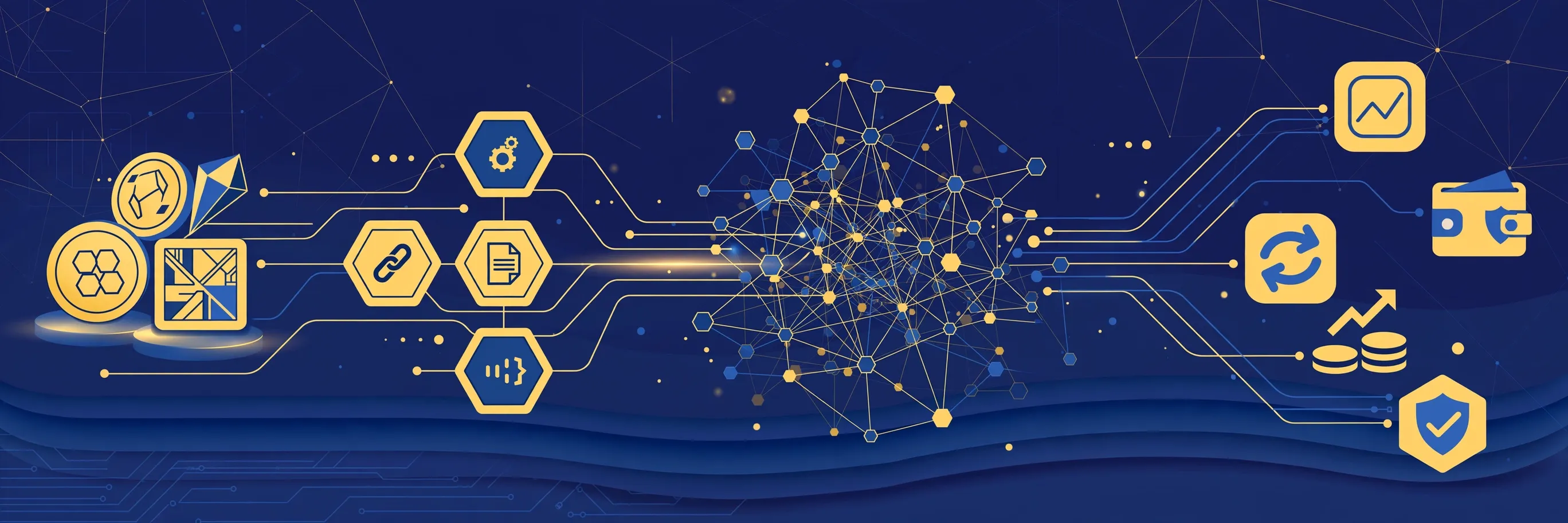
A decentralised finance ecosystem generally includes several interconnected components.
Blockchain infrastructure records transactions and establishes the rules under which digital assets can move. Different blockchains have different consensus mechanisms, transaction costs, performance characteristics, and security assumptions.
Smart contracts are programs deployed on compatible blockchains. They can automate actions such as exchanging tokens, distributing assets, or managing lending positions according to predefined conditions.
Digital assets and tokens provide the units that users transfer, exchange, or deposit into applications. Some tokens represent native cryptocurrencies, while others may represent claims or positions associated with another asset.
Applications and protocols provide interfaces through which users interact with the underlying infrastructure. Some are governed by decentralised communities, while others retain significant administrative control.
Understanding these components helps users distinguish between the blockchain itself and a service built on top of it.
How DeFi Networks Connect With Staking
Staking is one activity associated with the broader blockchain ecosystem. In proof-of-stake networks, participants may stake or delegate eligible tokens to help support consensus, subject to the network's rules.
Other services combine staking-related products with additional mechanisms intended to provide flexibility or reward accumulation. These arrangements may involve tokenised representations, lending strategies, or third-party protocols.
DeFi Networks describes a model designed to combine staking-related strategies with tokenised positions and flexible access to supported digital assets. Users should verify the precise mechanisms, fees, and withdrawal conditions associated with the service before participating.
Exploring the platform's stated DeFi network approach can provide a starting point for understanding how one service presents these features. Its current terms and technical documentation should be reviewed independently before any financial decision.
Why Tokenised Assets Matter
Tokenisation can represent an underlying asset or financial position through a digital token. Within a DeFi ecosystem, certain tokens can be transferred between wallets or used by compatible applications.
For example, a tokenised position may provide a separate way to represent exposure to cryptocurrency committed to a particular strategy. If the token is supported elsewhere, the holder may be able to transfer or deploy it without following the same process as a direct withdrawal of the original asset.
However, tokenisation does not automatically guarantee that the holder can redeem the underlying cryptocurrency whenever desired.
Users should verify the relationship between the token and its underlying position, including redemption rights, market availability, applicable fees, and the parties responsible for managing the assets.
Liquidity and Capital Efficiency
Liquidity is an important consideration when evaluating decentralised finance products. An asset with sufficient market liquidity may be easier to exchange, while an asset with limited demand may be difficult to sell without accepting a lower price.
Some DeFi strategies attempt to improve capital efficiency by enabling assets or tokenised positions to be used across compatible applications. This may create additional opportunities, but it can also increase the complexity of managing risk.
For instance, a position used as collateral in one protocol may become vulnerable to liquidation if its value falls below a required threshold. A failure in one connected protocol may also affect applications that depend on it.
Greater flexibility should therefore be evaluated alongside the additional risks introduced by interconnected systems.
Different Assets Require Different Approaches
DeFi Networks describes support for Bitcoin, Ethereum, Solana, and XRP. These cryptocurrencies do not all use the same consensus mechanism or operate in identical technical environments.
Bitcoin uses proof of work. Ethereum and Solana use proof-of-stake consensus mechanisms, while XRP follows a different consensus model.
This means that a product offering staking-related features across all four assets may rely on different processes for each one. It is important to identify whether assets are staked natively, represented through tokens, managed through an intermediary, or used in another strategy.
A platform's supported-asset list does not, on its own, explain how the assets are deployed or what risks are involved.
Rewards and Withdrawal Conditions
Some services advertise automatic reward accumulation or the ability to withdraw assets within a stated timeframe. These features should be assessed using the product's actual terms.
DeFi Networks describes ongoing reward accumulation and an unstaking period of up to 72 hours. Users should verify whether the timeframe remains current and whether it applies to every supported asset and every possible circumstance.
Rewards may depend on protocol performance, market conditions, fees, and the rules of the particular strategy. A displayed reward balance should not be treated as a guaranteed financial return.
Before depositing funds, users should also confirm whether withdrawals can be delayed by network congestion, liquidity shortages, technical issues, or additional verification requirements.
Cryptocurrency Risks and Brazilian Considerations
DeFi products can expose users to market volatility, software vulnerabilities, fraud, operational failures, and liquidity constraints. Depending on the arrangement, users may also face custody or counterparty risks.
A responsible evaluation should include the following checks:
-
Read the platform's terms and identify who controls deposited assets.
-
Review security disclosures and any available smart contract audit information.
-
Understand the fees, reward calculation, and withdrawal procedures.
-
Confirm the liquidity and redemption arrangements for tokenised positions.
-
Avoid assuming that advertised rewards are guaranteed.
-
Consider whether the product falls within applicable Brazilian regulatory requirements.
The Comissão de Valores Mobiliários (CVM) provides guidance on cryptoassets and explains that regulatory treatment depends on the characteristics of the asset and offering. Users should consult relevant official guidance when evaluating products available in Brazil.
Frequently Asked Questions
What is a DeFi network used for?
It can support blockchain-based activities such as token exchanges, lending, liquidity provision, and certain staking mechanisms.
Are all DeFi networks built on the same blockchain?
No. Different ecosystems operate on different blockchains, and some applications connect multiple networks through additional infrastructure.
Does a DeFi network guarantee investment returns?
No. Blockchain participation and decentralised finance strategies involve risks, and returns are not guaranteed simply because a product uses smart contracts.
Can tokenised assets always be withdrawn within 72 hours?
No universal withdrawal period applies. Any stated timeframe must be verified against the specific product's current terms and conditions.
Final Takeaway
A DeFi network connects blockchain infrastructure, digital assets, smart contracts, and financial applications into a broader ecosystem. Staking-related products and tokenised positions may provide additional ways to interact with cryptocurrency, but their benefits depend on the underlying design and conditions. For Brazilian users, reviewing security, liquidity, fees, withdrawal terms, and regulatory considerations is essential before committing funds.