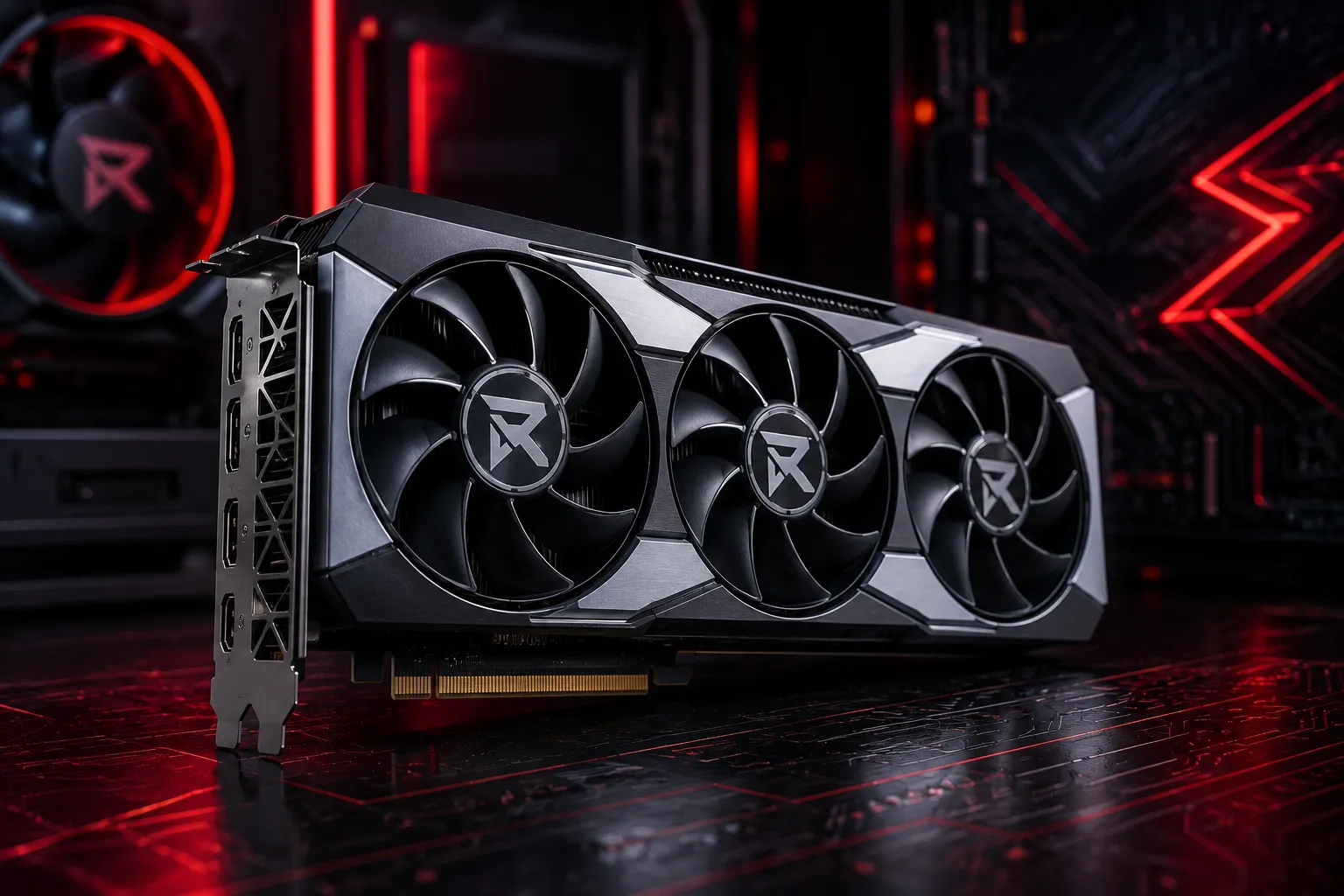
After more than a year as a China-exclusive graphics card, the AMD Radeon RX 9070 GRE has finally gone global. Announced alongside AMD's Computex 2026 lineup, the card is now available worldwide at a starting price of 549 US dollars, giving mainstream 1440p gamers another genuinely competitive option in a GPU market that has been anything but cheap lately.
If you are trying to figure out whether the RX 9070 GRE deserves a spot in your next build, here is a complete breakdown of its specs, performance, and where it actually fits in AMD's lineup.
From China-Only to Global Release
The RX 9070 GRE, which stands for Golden Rabbit Edition, originally launched in May 2025 as a China-exclusive card priced at 4,199 Chinese yuan. This is not unusual territory for AMD's GRE branding. The previous generation RX 7900 GRE followed a nearly identical path, launching exclusively in China before eventually reaching limited international availability.
That pattern repeated again in 2026. On June 1, AMD confirmed the RX 9070 GRE would become available globally through retail partners, finally giving gamers outside China access to a card that had been generating curiosity since its original regional debut.
Core Specifications
The RX 9070 GRE is built on AMD's RDNA 4 architecture using the same Navi 48 GPU found in the standard RX 9070 and RX 9070 XT, manufactured on a 4nm process with roughly 53.9 billion transistors packed into a 357 square millimeter die. AMD has trimmed the configuration down for this card, landing at 48 compute units, 3,072 stream processors, 192 texture mapping units, and 96 render output units.
For ray tracing and AI workloads, the card includes 48 dedicated ray tracing accelerators and 96 AI accelerators. Boost clock speeds reach up to 2.79GHz, which is actually higher than the standard RX 9070's clock speed, helping offset the reduced core count to some degree. Board power is rated at 220 watts, requiring two eight-pin PCIe power connectors, and the card supports modern display outputs including DisplayPort 2.1a and HDMI 2.1b.
Memory: Where the Real Trade-Off Lives
The most notable compromise on the RX 9070 GRE is memory. It ships with 12GB of GDDR6 VRAM across a 192-bit memory bus, delivering roughly 432 GB per second of bandwidth. That is a step down from the 16GB found on the standard RX 9070 and RX 9070 XT, and the memory itself runs at a slightly slower 18 Gbps compared to the 20 Gbps used on the higher-tier cards.
For most 1440p gaming scenarios, 12GB remains comfortably sufficient in 2026, though it does mean the GRE is less future-proof than its 16GB siblings for the most demanding, texture-heavy titles or extended use at 4K resolution.
Where It Sits in AMD's Lineup
AMD has positioned the RX 9070 GRE squarely between the RX 9060 XT and the standard RX 9070, both in terms of specifications and price. At 549 US dollars, it sits well below the roughly 600 dollar street price of the RX 9070, while offering a meaningful step up over the 9060 XT in raw compute power and ray tracing capability.
Some reviewers have noted that the naming convention here feels a little awkward, suggesting the GRE almost plays the role that a 9060 XT successor might have, while the current 9060 XT arguably should sit a tier lower. Regardless of naming quibbles, what matters most to buyers is the actual price-to-performance ratio, and that is where the GRE earns its place in the lineup.
How It Performs in the Real World
Early benchmarks paint a picture of a card that performs close to the standard RX 9070 despite its reduced specifications, largely thanks to those higher clock speeds compensating for fewer cores. Comparisons against Nvidia's competing RTX 5060 Ti 16GB have been particularly favorable, with some outlets reporting the RX 9070 GRE outperforming it by roughly 22 percent at 1440p resolution.
Power efficiency is another area where the GRE shows real improvement. Under load, it peaks at around 196 watts, compared to nearly 248 watts for the standard RX 9070. That is a meaningful difference for anyone building a smaller form factor PC or trying to manage thermals and electricity costs more carefully.
FSR 4 and AI-Powered Enhancements
The RX 9070 GRE supports AMD's FSR 4 upscaling technology, which has continued to close the gap with Nvidia's DLSS in terms of both image quality and adoption across major titles. Combined with the card's dedicated AI accelerators, FSR 4 helps the GRE punch above its raw hardware specifications in supported games, particularly at 1440p where upscaling technology tends to deliver the most noticeable benefits.
Is the RX 9070 GRE Worth Buying?
Whether the RX 9070 GRE makes sense for your build largely comes down to actual street pricing once retailers get their hands on it. If it consistently sells at or near its 549 dollar MSRP, it stands as one of the more compelling value options for 1440p gaming in AMD's current lineup, especially against Nvidia's similarly priced offerings.
That said, the calculation shifts quickly if pricing creeps closer to the standard RX 9070. With memory supply constraints continuing to push GPU prices upward across the board in 2026, the GRE's value proposition may prove more fragile than AMD intends, depending entirely on how disciplined retail pricing ends up being.
Final Thoughts
The AMD Radeon RX 9070 GRE's journey from a China-exclusive curiosity to a globally available 1440p value option makes it one of the more interesting GPU stories of 2026. With 12GB of VRAM, solid ray tracing performance, and FSR 4 support, it offers a genuinely capable middle ground between AMD's budget and high-end RDNA 4 offerings.
If you can find it close to its 549 dollar MSRP, it is well worth considering for a 1440p gaming build. Just keep an eye on real-world retail pricing before committing, since that single factor will determine whether the GRE lives up to its value-focused positioning. It is also a graphics card that should perform well across a wide range of modern titles featured in video games review benchmarks, making it an appealing choice for gamers who value both performance and long-term reliability.
Frequently Asked Questions
What does GRE stand for in the RX 9070 GRE?
GRE stands for Golden Rabbit Edition, a naming convention AMD previously used for the RX 7900 GRE.
How much does the AMD Radeon RX 9070 GRE cost?
AMD has set a global MSRP of 549 US dollars for the RX 9070 GRE.
How much VRAM does the RX 9070 GRE have?
It includes 12GB of GDDR6 memory across a 192-bit bus, less than the 16GB found on the standard RX 9070 and RX 9070 XT.
Is the RX 9070 GRE good for 1440p gaming?
Yes. It is specifically positioned as a 1440p gaming card and performs competitively against similarly priced options like Nvidia's RTX 5060 Ti 16GB.
Was the RX 9070 GRE always available globally?
No. It originally launched as a China-exclusive card in May 2025 before AMD expanded availability worldwide starting June 1, 2026.
How does the RX 9070 GRE compare to the standard RX 9070?
It has fewer compute units and less VRAM, but higher boost clocks help it perform close to the standard RX 9070 in many scenarios, at a lower price point.
Does the RX 9070 GRE support FSR 4?
Yes. It supports AMD's FSR 4 upscaling technology, which improves both performance and image quality in supported games.